Meet the Family: Episode 5- Leonard and Mary Tyson Styer

As is often the case with studying history, the story of Leonard and Mary T. Styer is one rife with significant answered questions. I will begin with what I do know about their lives, and finish with three questions and some historical speculation.

Our ancestor Leonard was the first in our branch of the family to use the “Styer” spelling of the name instead of Steiger/Steyger. He is also significant in that he is the first of our Styer ancesters to move to northern Pennsylvania.

He was born the day his parents moved to Whitpain Township, Montgomery County, PA in 1768. Leonard was the youngest of the family and does not seem to have inherited any land. Instead, young Leonard invested “extensively” in tavern properties. It is recorded that at one time he owned the Broad Axe Hotel, the Waggon Inn in Center Square, the Rambo House in Norristown, and another hotel in Philadelphia.[1]
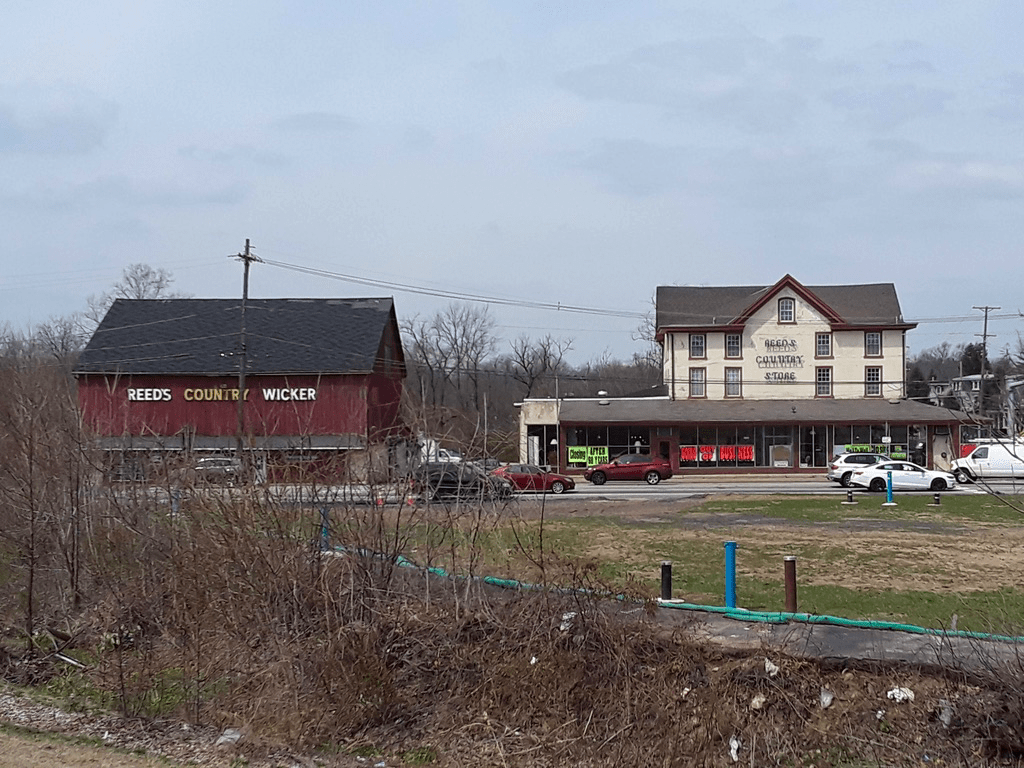
Reed’s Country (Furniture) Store was once the Waggon Inn, a tavern owned by our ancestor, Leonard Styer. It appears to have to retained its livery stable/barn on the left. These structures were once a necessity at taverns in the days of horse and wagon travel. Photo from private collection.

At some point, in the early nineteenth century, Leonard sold these properties took his family, moved north, and became a farmer in Newport Township, Luzerne County, west of present-day Nanticoke, PA.[2] Between the Spare Book and the Biographical Annals of Columbia and Montour Counties there are some discrepancies as to the date of this move. The BACMC says Leonard and Mary took their family to Luzerne County in 1814. The Spare book says 1807. The Spare book goes on to say that he lived in Luzerne County for twenty years and then returned to Montgomery County, where he lived in Franklinville for fifteen years, before he moved to Columbia County, where he died near Berwick. None of this is mentioned in the BACMC. If the family moved to Luzerne county in 1814, then Leonard would have to be significantly older than the age on his tombstone if we believe the information provided in the Spare book. It’s hard to know exactly what happened or exactly which account is true.
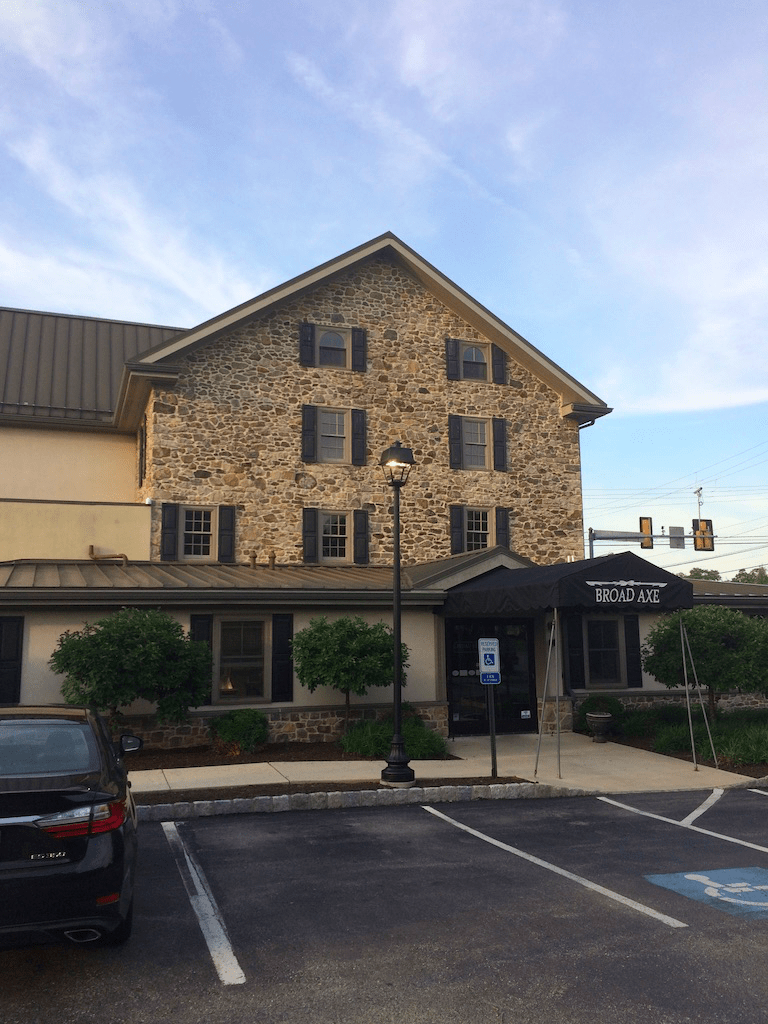
The Broad Axe Tavern, once under the ownership of our ancestor, Leonard, was at the time I visited it, a pleasant pub and eatery. Since the time I visited, it has closed. Photo from private collection.

Leonard married Mary Tyson at some point before the turn of the nineteenth century and had the following children:

  1. Joseph (1798-1864) married Rachel Kidney (1797-1880), moved to Ohio. His son George Styer (1840-1863) was a victim of the Civil War, mortally wounded during the Siege of Vicksburg, MS. He died at an Army hospital in St. Louis, MO. He was a soldier in the 96th Ohio Infantry. Several others of Joseph and Rachel’s sons fought in the Civil War and survived.
  • Elizabeth (1800-1862) married John Hoffman. She is buried in Berwick next to her father. John Hoffman cleared a 170-acre farm near Berwick after serving his country in the War of 1812. He died in 1849, at age 75 according to Battle’s History of Montour and Columbia Counties.
  • Esther (1803-1805) died young.
  • Henry (1805-1875) farmer in Bradford County, near Towanda, PA. He married Anna Fairchild, who died in 1844[3], then married Martha Lewis on 7/17/1846, who died in 1872.  Henry’s obituary, one of the oldest Styer obits to which we have access, reads thus: “”Henry Styer died February 10th, 1875, at Spring Hill where he resided for some twenty-six years past. He was born in Montgomery county, in 1805. He was a man of great force of character and whatever he did, was with a determination to succeed. In point of intelligence he was considerably above the average. He had positive convictions, and did his own thinking. Although born in a tavern, he was always an advocate of temperance, even refusing while in the mercantile business, to sell tobacco, choosing to lose custom rather than rob families of that which ought to go for bread. For many years he was a prominent member of the Presbyterian Church. Subsequently he adopted different theological views, but during the last few years of his life we believe he gradually came back to his earlier faith. As a friend and neighbor, we miss him much.” Both he and Martha are buried in Spring Hill, Bradford County, PA.
  • Cornelius Tyson Styer (1807-1872) married Rosanna Fairchild (Her sister was the above Anna Fairchild). They were married in 1833.[4] These are our direct ancestors and will be the topic of another blog.
  • David (1810-1881)[5] married Mary Ann Jones. Lived in Burlington New Jersey. Some of his children stayed in New Jersey and some moved back to the Philadelphia area. His grandson, Jones Styer, went north to Alaska during the Klondike Gold Rush.
  • George W. (1814-1877) married Catherine Hartman then Rebecca Arnwine (1821-1873). Their son, Corporal John H. Styer of the 84th PA Infantry was mortally wounded during the Civil War battle of Fredericksburg, VA and died at the Armory Square Hospital in Washington D.C. George and Rebecca are buried at Columbia Hill. In 1860 George Styer was listed in the census for Briarcreek Township as Justice of the Peace.

Burial

Leonard Styer died in 1843 and is buried in the main cemetery in Berwick, PA. According to the BACMC, Mary is also buried there, but I was unable to locate her grave. Leonard rests near his daughter Elizabeth (Styer) Hoffman and grandson (through his son George) John H. Styer, who was mortally wounded at the Battle of Fredericksburg, VA during the Civil War. Nearby the Berwick Styer grave plot lie the bodies of two steamboat operators who were killed during the last attempted steamboat navigation of the Susquehanna River.
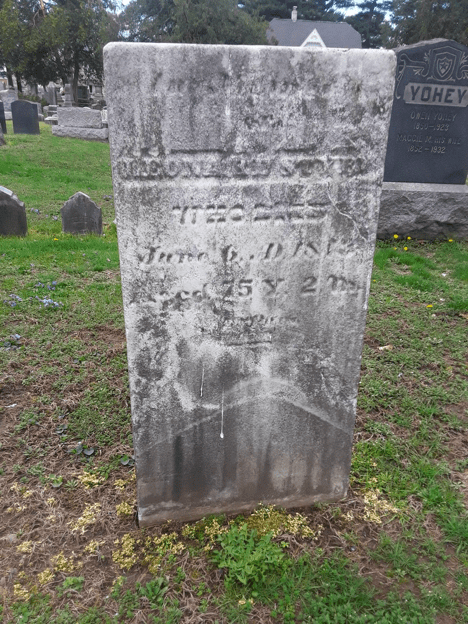
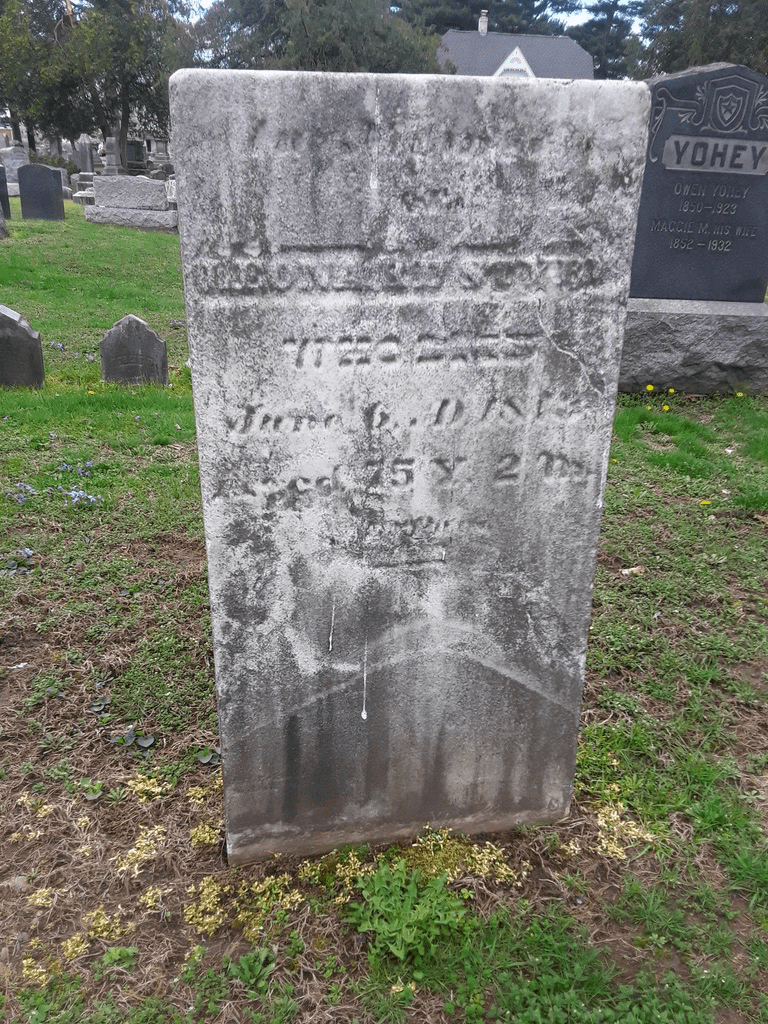
Leonard Styer’s tombstone in the Pine Grove Cemetery in Berwick, PA. Supposedly Mary T. Styer is also buried there. I have yet to discover it if the stone still exists. It may stand elsewhere. There is much documentation to be done in this cemetery. Photo from private collection.

Legacies, Unanswered Questions, and Speculation

Leonard and Mary Styer leave several important legacies. First, is that they appear to be the first of our ancestors to use the current “Styer” spelling. They also were the first of the Styer line to migrate to the North Branch valleys which continue to be home to many of us. It is hard at this point to get to the bottom of several questions I have regarding this generation of the family.

Question: Why did Leonard leave Montgomery County?

Possible Answer: Being the youngest of his siblings, Leonard did not inherit any of his parent’s land, so there was not much binding him to life in an increasingly more populous Montgomery County. After at first investing in tavern properties, he eventually sold them all and became a farmer in Luzerne County. Another question we may never know the answer to is why he got out of the tavern business in the first place. Perhaps he had a religious experience. We may never know.

Question: Why are Leonard’s tavern businesses not mentioned in the Biographical Annals of Columbia and Montour Counties?

Possible Answers: It is interesting to note that the Biographical Annals of Montour and Columbia Counties (BAMCC) (from which the narrative in the Pink Book is drawn) does not mention his dealings in the tavern business, although the Spare Family book goes into some detail concerning these dealings. Why the discrepancy? Cyrus Styer would have been the main informant for that history, and one would assume he would know that his grandpa was a businessman involved in taverns before he moved upstate. Is the lack of this information in the BAMCC a reflection of ignorance on Cyrus’ part? Or does its omission reflect his strict Prohibitionist sensibilities? We may never know!

Question: To what religious denomination did Leonard and Mary Styer belong?

Possible Answer: Probably either Presbyterian or German Reformed. Leonard came from a mixed background of Mennonite and German Reformed. Mary’s parents are buried in a German Reformed cemetery, so we can assume she was Reformed. We know that their son, Cornelius Styer, was a Presbyterian, but that could have been influenced by his wife Roseanna Fairchild, whose family was Presbyterian. Due to the fact that Leonard and Mary were buried in a town (rather than church) cemetery confuses things, however, Presbyterian and German Reformed denominations are very similar, sharing Calvinistic beliefs and differing only in the confessional standards they use (Westminster Standards and the Heidelberg Catechism/Three Forms of Unity, respectively).

Next time on Meet the Family: The Fairchild connection. There are some exciting people in this family tree, and as usual some great history! Thank you for reading Styer Stories!


[1] Spare Book, p. 170.

[2] Pink Book, p. s????

[3] Anna Fairchild Styer (1809-1844) is buried with her Fairchild ancestors in the Newport Center Cemetery. She was sister to Rosanna Fairchild who married Cornelius Tyson Styer

[4] BAMCC, p. 496

[5] Find a Grave page

Der Wunnerfitz: Episode 1- What’s in a name?

Today I will be answering a question posed by a reader. Questions or extra items come up, I will entitle blogs like these “Der Wunnerfitz” or the curious one in Pennsylvania Dutch.

“A rose by any other name would smell as sweet” -Shakespeare

So what’s up with the Steiger-Styer thing? In a Facebook comment the other day, a fellow member of the Ralph Styer branch of the family, Jean (Styer) Goley, asked me if I could explain why our immigrant ancestors’ name was changed from Steiger to Styer.

No photo description available.
The grave of Jacob Steiger, our first ancestor to be born in North America.Notice the old spelling of the name. Located in the Methacton Mennonite graveyard.

Many of us have heard stories about immigrants getting their names changed at Ellis Island because the immigration officials recording their entry could not spell the complicated Eastern or Southern European names. This is undoubtedly true for people who came to the United States in the late 1800s and early 1900s. However, this situation does not necessarily apply to families like the Styers who came long before the use of Ellis Island as a receiving facility for new arrivals to our country (which was in 1892).

The bottom line is that in pre-modern times, especially before modern record-keeping and government bureaucracy, folks didn’t really seem concerned how their name or anyone else’s was spelled. As long as it could be pronounced the same way, it was usually fine. It is not hard to find eighteenth and early nineteenth-century legal documents like wills or property deeds that have the name of the same person spelled several different ways on the same page.

The Grave of Leonard Styer, Grandfather of Cyrus. Leonard was the first of our direct ancestors to use the current spelling of the name. Leonard is buried in the Berwick Pine Grove Cemetery.

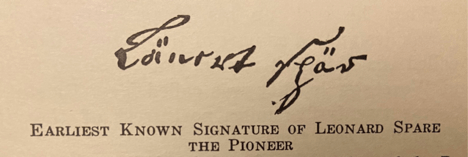
This all explains situations like Leonard Spare’s. He phonetically spelled his name Spär or Spehr on several documents, but where did the “G” go in Steiger? A whole consonant is missing! However, early documents show spellings like Steier and Steyer as alternates to Steiger or Steger, so there must be a phonetic component to this. The reason behind the flexible G situation is because in Pennsylvania German (Pennsylfaanisch Deitsch), a dialect of southern (or High) German, the letter “G” in the middle of a word is very soft and is spoken more like a y; almost like the Spanish “ll” in quesadilla.

If anyone digs deep enough into their geneology, they will find that their ancestors were pretty flexible in the spelling of their surname. In my Shifflet family line alone, I have seen the name spelled Shiflet, Shifflett, Shifflette, Schifflet, Shiflett, Shiplett, and more. Our Tyson ancestors originally spelled their surname “Theissen.” On the Fairchild side, we have Lutsey ancestors who first spelled their name, Lutze (pronounced Lootsah).

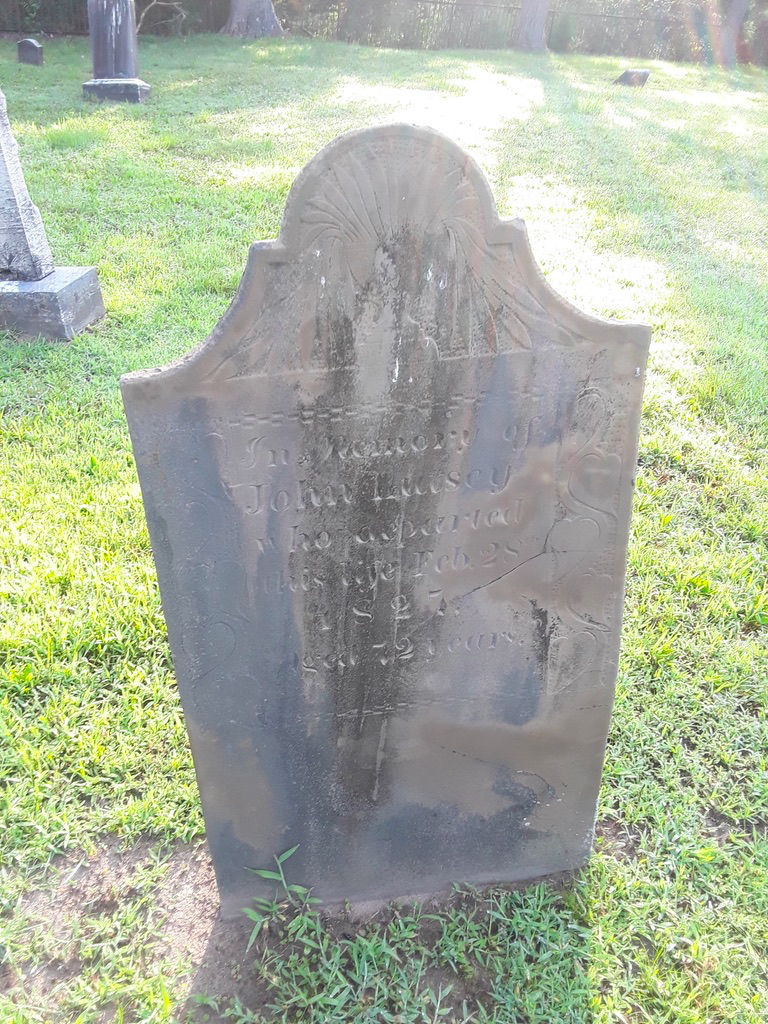
The grave of Johann Andreas Lutze AKA John Lutsey. He was born in Germany and is one of our ancestors on the Fairchild side of the family. We will study him later on in the “Meet the Family” episodes. Lustey is buried in the Newport Center Cemetery in Luzerne County. Photo taken from https://www.findagrave.com/memorial/24124309/john-lutsey

Although phonetic and cultural reasons for differing name spellings existed, there were also social and grammatical reasons as well. Some Pennsylvania Germans (and other nationalities) changed their name to look or sound more English, especially if they were trying to climb the social ladder. Many Schmidts, Brauns, Müllers, and Kochs became Smiths, Browns, Millers, and Cooks. Indeed, there were many Gingerichs who became Gingerys because the German pronunciation of “ch” was too complicated. As mentioned before, it has been said that our ancestor Leonard Styer was the first to use the current spelling of our name. As a businessman (he owned taverns), so he may have adopted the current spelling for social reasons. It’s hard to know the exact motivation behind the decision.

The other reason for the variety of name spellings among the Pennsylvania Dutch is that there was widespread debate on how to write the language. Should PD writers use German spelling, grammar, and mechanics (like umlauts and eszetts) or should they use English spelling, grammar, and mechanics? To make this all even more confusing, in 1834, the State of Pennsylvania enacted a compulsory English-only education policy in public schools, preventing Pennsylvania German students from learning the rudiments and grammar of their mother tongue in public schools. These conditions led to a situation where Pennsylvania German spelling was a merely subjective affair.

The specific reasons for the eventual choice of the current “Styer” spelling are lost in the mists of time, but hopefully the above information explains possible reasons for its change. All of this demonstrates that when studying genealogy, it is wise never to grow too fond of a particular spelling of one’s name!

Meet the Family: Episode 4- The Tyson Connection

Leonard Styer (1768-1843), son of Jacob and Christana (Spare) Steiger married a woman named Mary Tyson in the late 1700s. Before the Leonard and Mary (Tyson) Styer blog, I will give a brief introduction to the Tyson Family. Due to the Tyson connection, our branch of the Styer Family has roots that go back all the way to the original founders of Germantown, the very first settlement of the Pennsylvania Dutch. It is like the Pennsylvania German equivalent of Jamestown or Plymouth Rock. So even though we don’t have any Styers who came over on the Mayflower, we have ancestors who came to America on the Concord, the first ship to bring the people later known as Pennsylvania Germans to America.

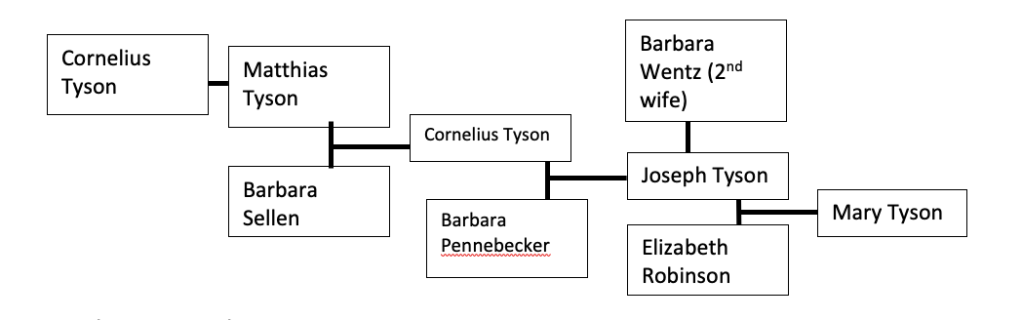
Here is a simple family tree showing Mary (Tyson) Styer’s ancestry back to Cornelius Tyson.

Cornelius Tyson, the Immigrant

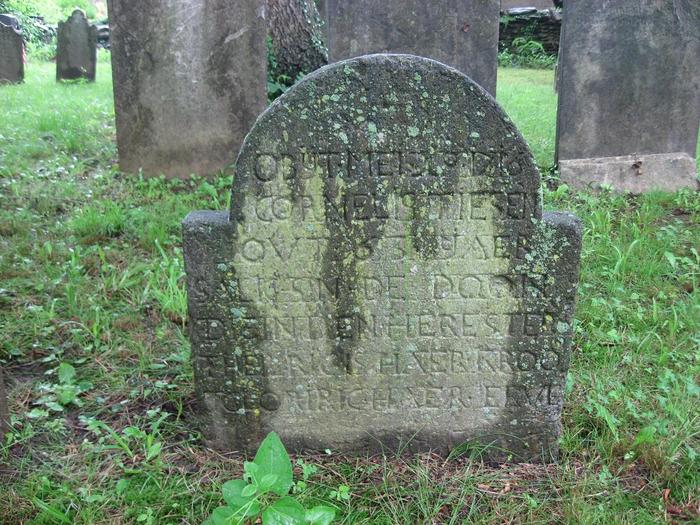
Like many of the early Germantown Settlers, Cornelius Tyson/Theissen (1652-1719) was a weaver from along the Rhine, near Crefeld, close to the border between Germany and Holland. He is thought to be the brother of Reynier Tyson, who led one of the original 13 families of Germans to sail to America on the Concord and settle in Pennsylvania in 1683. Cornelius may have come to America as early as 1685 but was definitely a resident by 1703.[1] Like the other settlers, Cornelius was a German Quaker who may have had Mennonite sympathies. His 1719 gravestone is the oldest extant German-language gravestone in the United States. You can visit it in the Upper Burial Ground along Germantown Avenue in Philadelphia at the site of the old Concord Schoolhouse. The cemetery is well maintained, and a branch of the Tyson Family from Ohio recently got together to commemorate this ancestor by dedicating a brass plaque at the foot of the stone.

Our grandfather, Cornelius Tyson’s grave. Thought to be the oldest extant German language grave marker in America. Photo taken from https://www.findagrave.com/memorial/28078440/cornelius-doors-tiesen
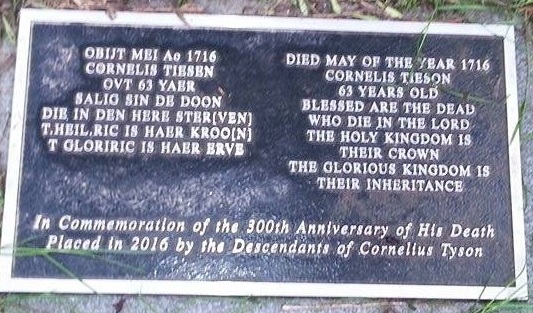
The recent memorial erected by a group of our Tyson cousins at the foot of Cornelius’ grave. It shows a transcription and translation of the writing. Photo taken from https://www.findagrave.com/memorial/28078440/cornelius-doors-tiesen

Tyson Descendants

Cornelius’ son, Matthias (1687-1766). Married Barbara Sellen, whose father, Hendrick, led one of the original 13 families who settled in Germantown and also was a trustee of the Germantown Mennonite congregation. They built a homestead in Perkiomen Township, currently Montgomery County, PA. I have not been able to locate Barbara’s grave, but Matthias is buried in the Lower Skippack Mennonite cemetery in a grave marked with a carved field stone.

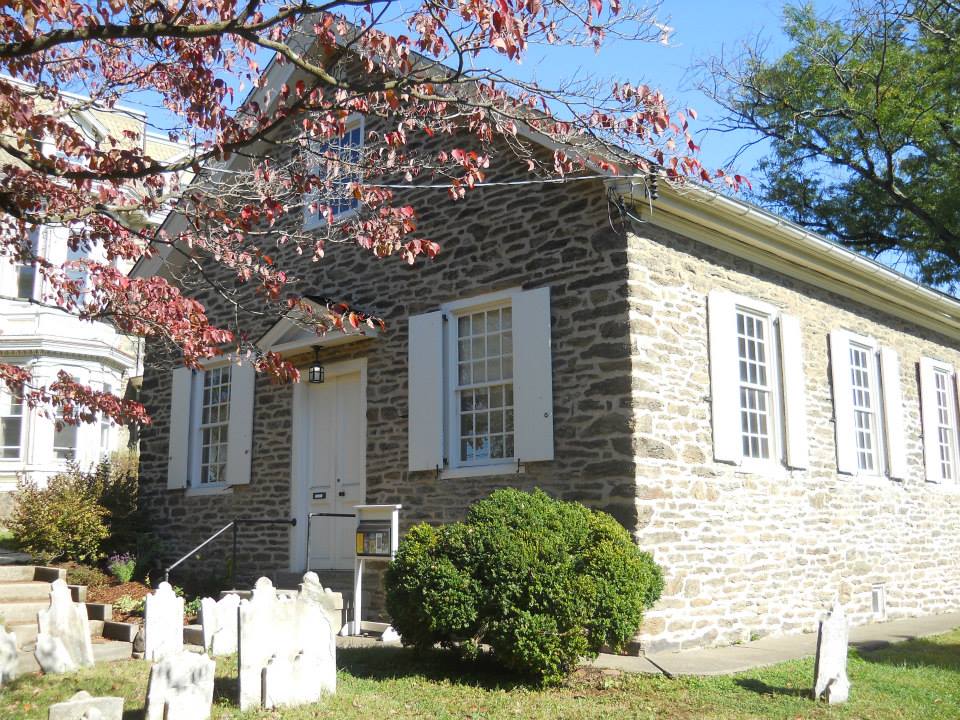
Germantown Mennonite Meetinghouse, owned by the oldest Mennonite congregation in the Western Hemisphere
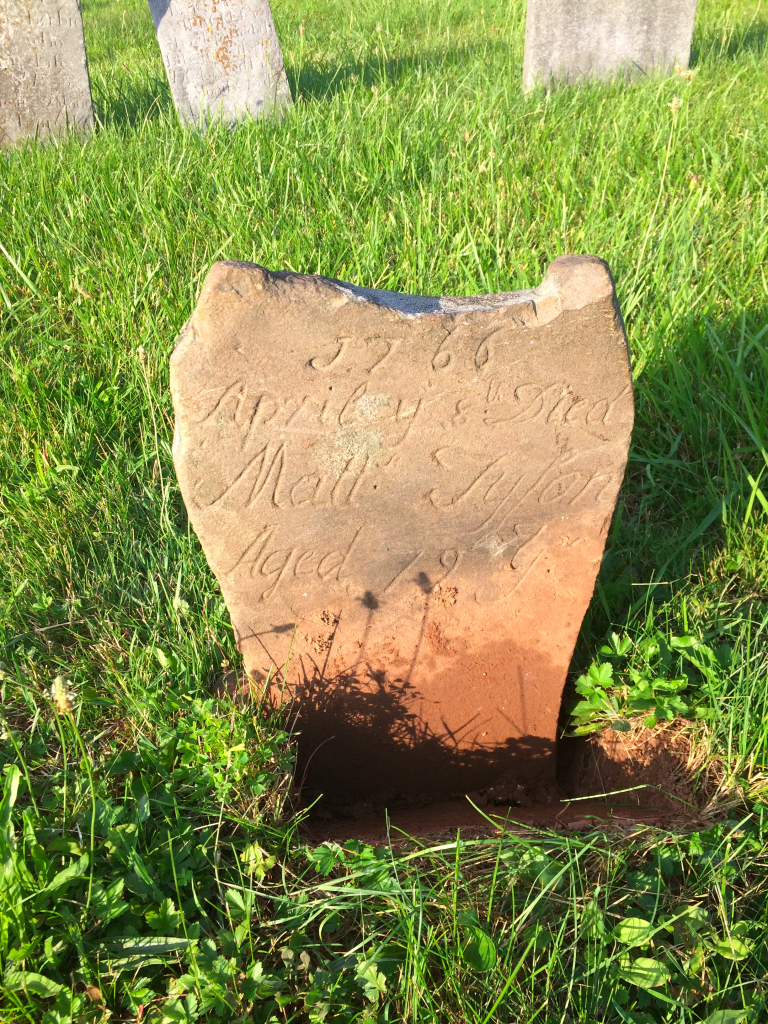
Matthias Tyson’s Gravestone is not very deep and has a propensity to fall forward. I searched for nearly an hour to find it.
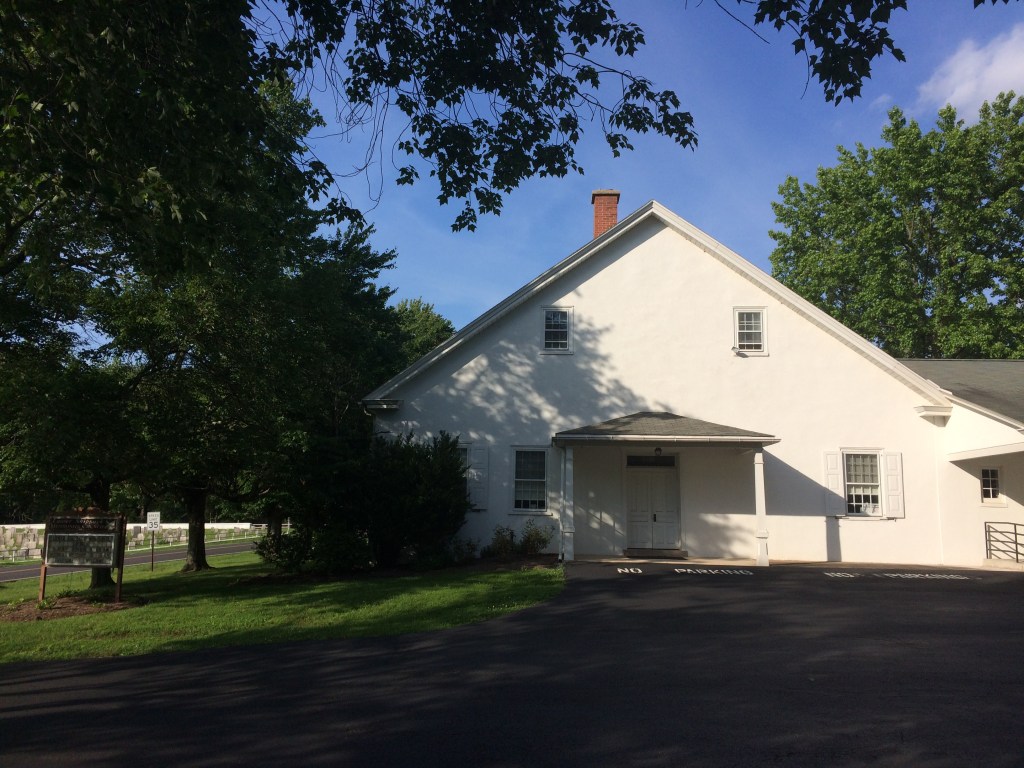
Lower Skippack Mennonite Church, where Matthias Tyson and many other ancestors are buried.

Matthias son Cornelius (1720-1752) married Barbara Pennebaker/Pennypacker (1720-1761) in 1738. Barbara’s father was Hendrick Pennebaker who was a Germantown settler.  Cornelius farmed his father’s homestead in Perkiomen township.[2] Our Pennebaker ancestry makes us distant cousins to the Honorable Samuel W. Pennypacker, Governor of Pennsylvania. I will focus on the Honorable Samuel in a future blog. As far as I can tell, no gravestone exists for Cornelius or Barbara.

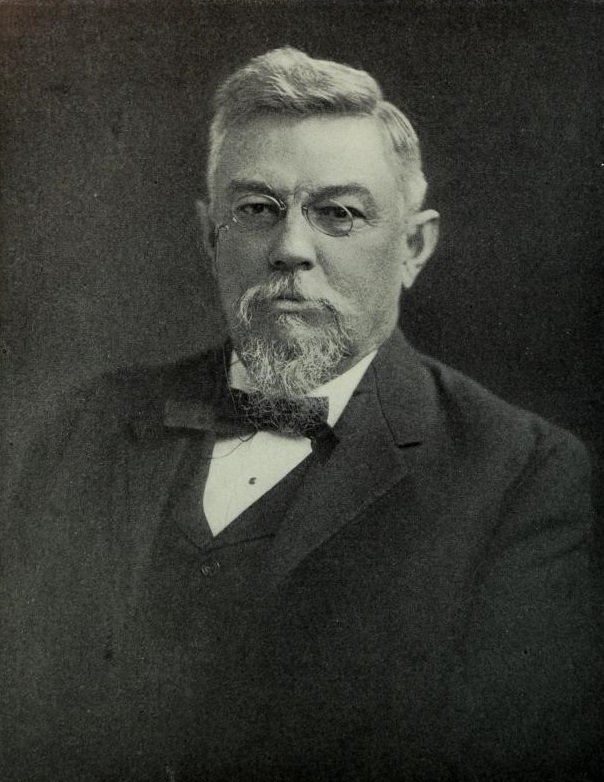
Governor Samual W. Pennypacker, our cousin through both the Tysons and the Sellens. Pennypacker was a Civil War veteran, judge, politician, writer, linguist, historian, and genealogist. Photo taken from https://en.wikipedia.org/wiki/Samuel_W._Pennypacker#/media/File:Portrait_of_Samuel_W._Pennypacker.jpg

Cornelius son Joseph (1752-1829) was a tavern owner and farmer. His obituary referred to him as “Big Joe Tyson.” Tyson’s tavern was an important meeting place during the last part of the eighteenth and the early part of the nineteenth centuries.[3] It was used to hold political meetings for Federalist and Democratic Republican voters during the 1790s. In 1811 it is recorded the local militia met there to elect officers.[4]

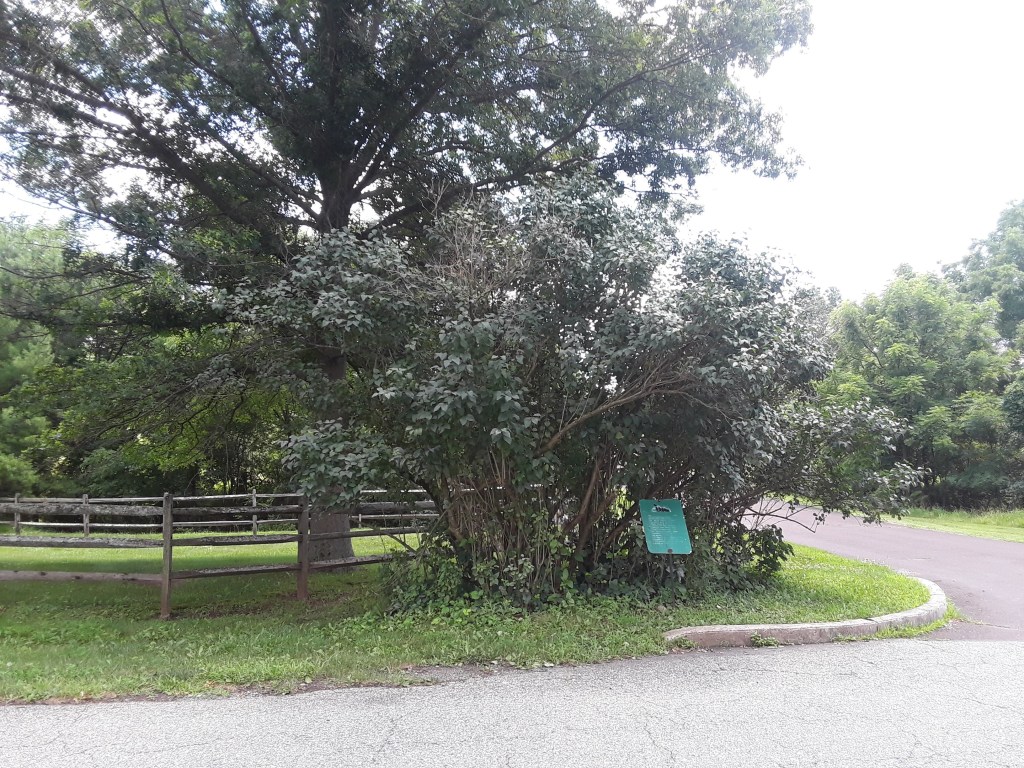
Joseph built his tavern near an older one where his wife’s relative, Jacob Wentz, had operated a tavern previously. During the 1777 Philadelphia Campaign during the Revolution, George Washington used Wentz’ Tavern as his headquarters. Over the years, both taverns were demolished, but I have visited the site which is marked with a very old lilac bush.

The bush which marks the site of the Wentz tavern. The sign reads: “1764-1986 This 222 year old lilac bush marks the site of the Jacob Wentz Tavern. The entrance to deer creek road is on the roadbed of the original Skippack Pike over which George Washington and the Revolutionary Army Traveled on their way to the Methacton Hills, two miles east. There they encamped until October 4, 1777 when they fought the Battle of Germantown.

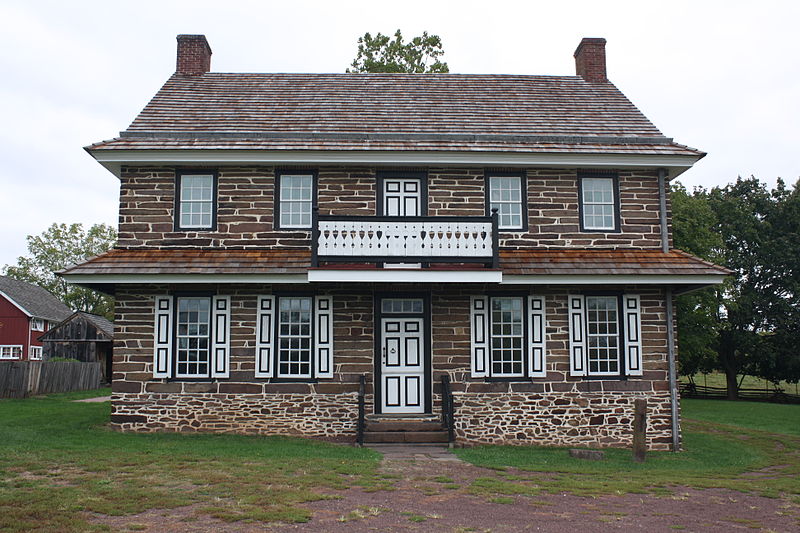
Joseph Tyson was married twice, first to our grandmother, Elizabeth Robinson (1753-1783), until her death. He then married Barbara Wentz (1756-1825), the daughter of Peter Wentz. This marriage took place at 2nd Presbyterian Church in Philadelphia.  His 2nd father-in-law, Peter Wentz, was a wealthy farmer, whose house and farmstead have been lovingly restored as a museum, which I highly encourage anyone with an interest in history, architecture, or folk art to visit. The Peter Wentz House is a true gem of Pennsylvania German culture.

The Peter Wentz Farmstead Museum. Wentz was our step-ancestor, whose daughter, Barbara, married our ancestor, Joseph Tyson. I can’t recommend this museum highly enough. A beautiful property and home. Hint: Check out photos of the painted interior wall designs!


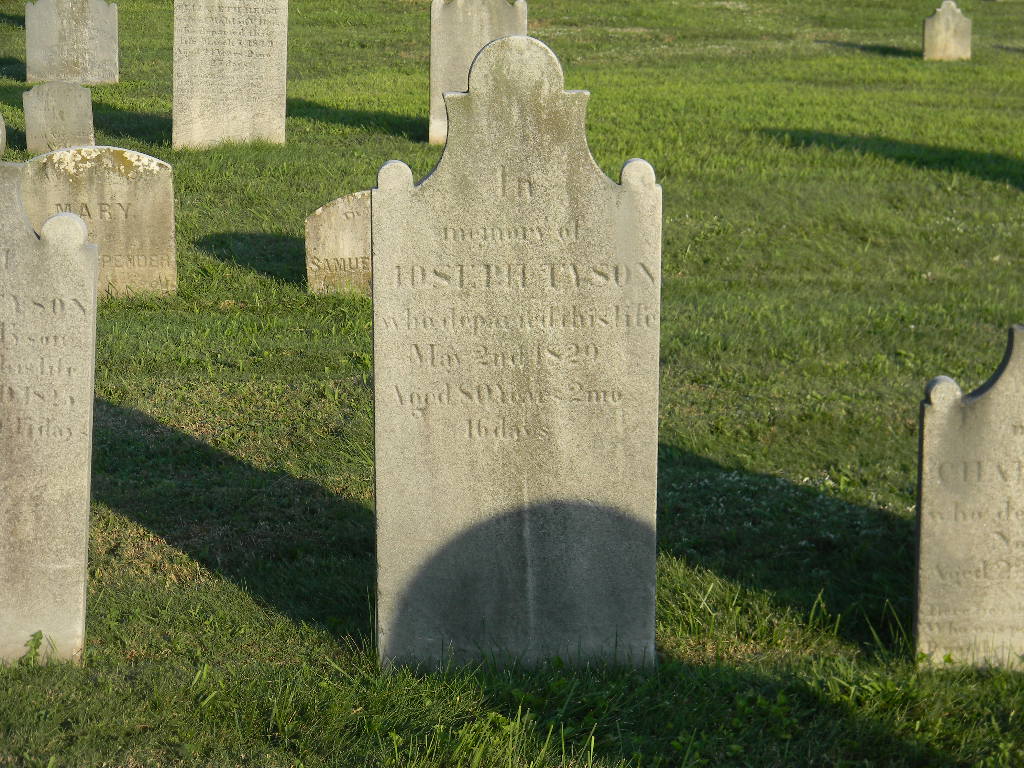
 Joseph Tyson’s tavern is now gone, demolished in 1864.   Big Joe was laid to rest along with his 2nd wife at the Wentz’ Reformed Church near our Spare ancestors. Joseph’s daughter Mary married Leonard Styer, and we will pick up with those two in the next blog. 

The Grave of Joseph Tyson at Wentz’ Reformed (UCC). Photo taken by https://www.findagrave.com/memorial/89048812/joseph-tyson
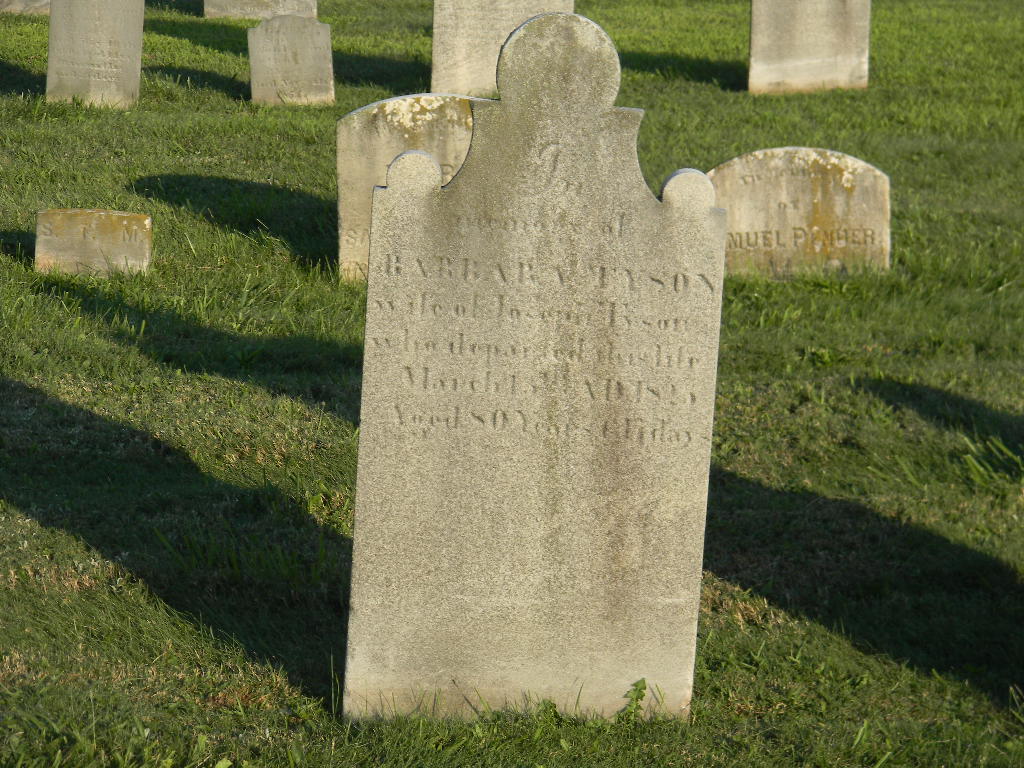
The grave of Barbara (Wentz) Tyson at Wentz’ Reformed (UCC). Photo taken from https://www.findagrave.com/memorial/89048823/barbara-tyson

Tyson Cousins:

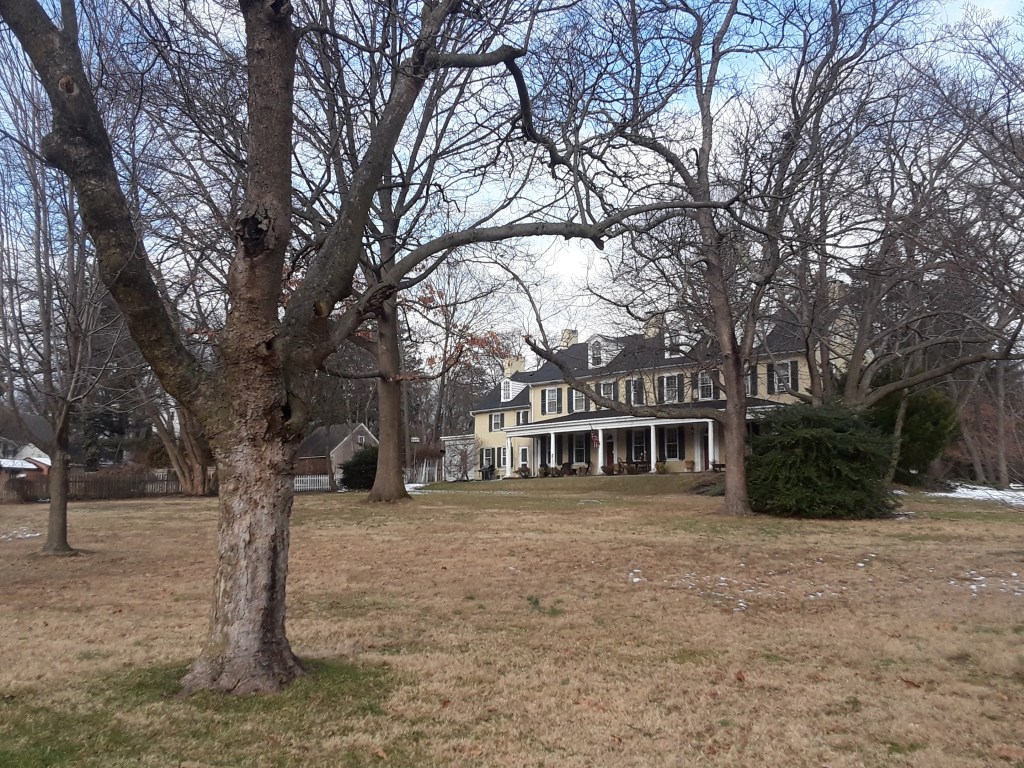
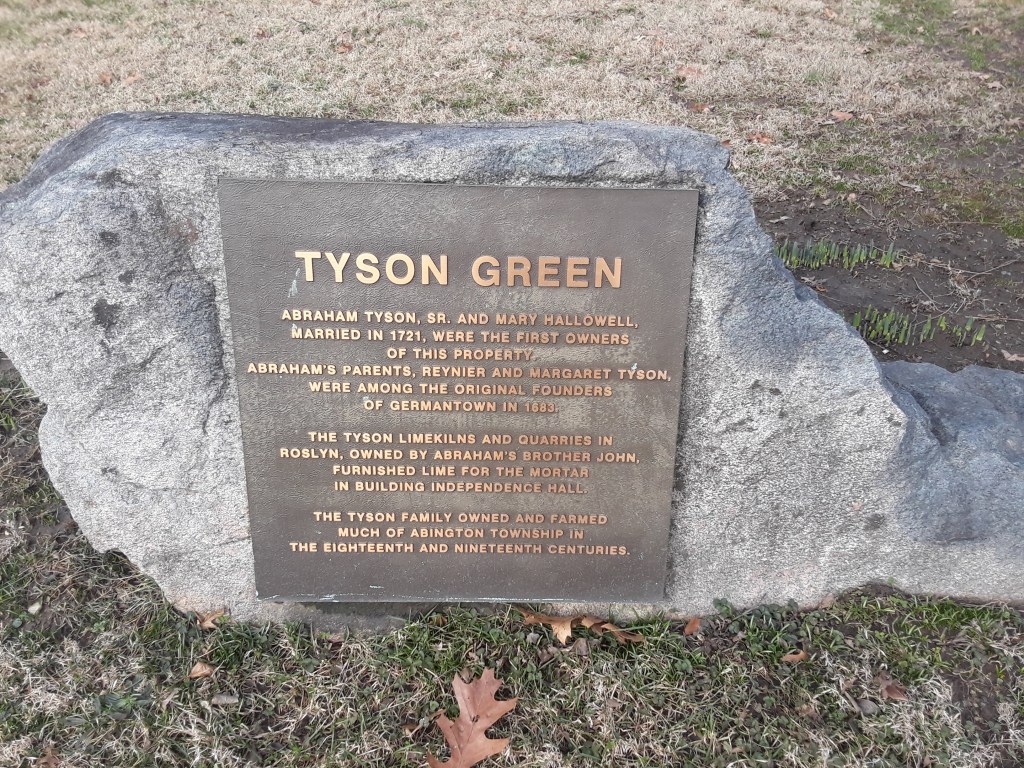
I already mentioned Reynier Tyson, who was likely the brother of our ancestor Cornelius Tyson. Reynier led one of the original 13 families who came to Philadelphia on the Concord. While I was living outside Philadelphia I discovered some fun facts about some of Reynier’s descendants, who would be cousins of ours. Reynier Tyson’s son, Abraham and his wife Mary (nee Hallowell) built a stately home known as Tyson Green which lies just north of the borough of Jenkintown. Among other things, this family operated some lime kilns, which were facilities which converted limestone into lime by heating it up with charcoal. Lime was used to make mortar and whitewash paint or can be applied to farmland to lower soil acidity. The Tyson kilns provide the name for the Limekiln Pike which runs through North Philadelphia into Montgomery County.  Incidentally, mortar made from lime produced at the Tyson kilns was used in the construction of Independence Hall in Philadelphia. A lasting family legacy indeed!

Join us next time as we dive into the mysterious lives of Leonard and Mary (Tyson) Styer.

The Tyson Green house just north of Jenkintown, PA.
Plaque at Tyson Green.

[1] Jordan, John W., Colonial and Revolutionary Families of Pennsylvania, (New York & Chicago, 1911) p. 395.

[2] Ibid, p. 396.

[3] A History of Worcester Township, 1976, p. 48.

[4] In the days before the organization of the National Guard, each county had a militia system to provide troops in case of emergency. A couple times per year, the men would don their uniforms and get together for drill practice. Usually these affairs would create a good excuse for a picnic and a little drinking. An interesting feature of Pennsylvania militias since the Revolutionary War was that the men elected their officers.

Meet the Family: Episode 3- Jacob and Christiana Steiger

John Stephan and Gertrude Steiger’s son Jacob (1719-1777) and Leonard and Elizabeth Spare’s daughter Christiana (?-?) were married in 1746.[1]  Jacob and Christiana are our first ancestors in the Styer line to be born in America.

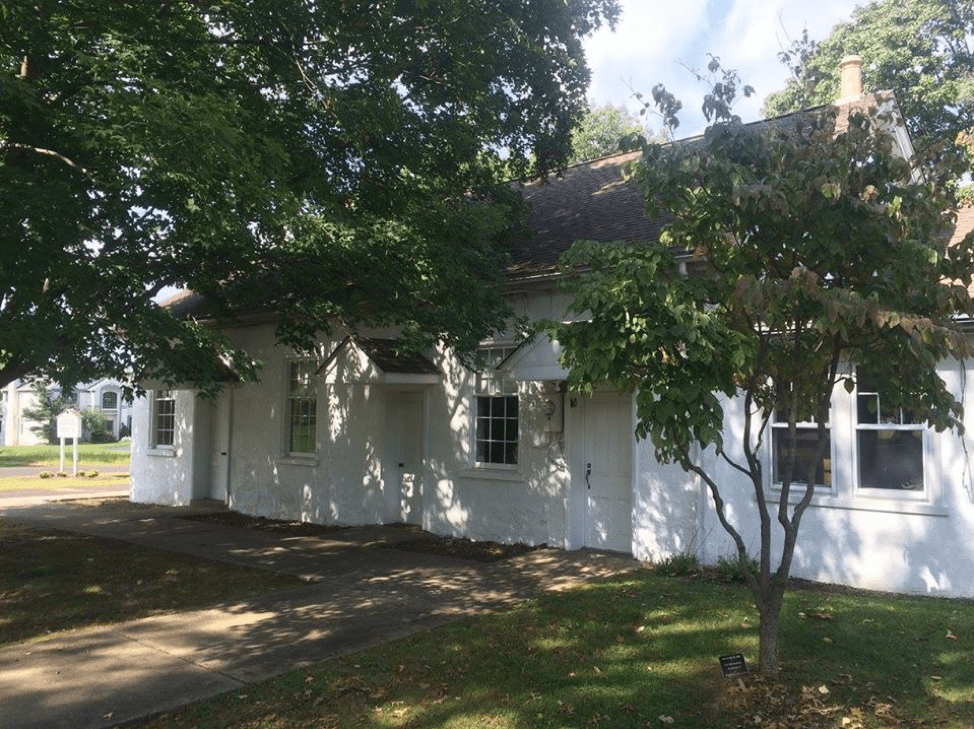
Methacton Mennonite Meetinghouse

One tangible legacy of our Styer/Steiger ancestors is the Methacton Mennonite Meetinghouse. In 1739, three years after the death of John Stephan Steiger, Jacob and his mother, Gertrude, donated 32 perches of land for the construction of a Mennonite Meetinghouse and cemetery. The Steigers were joined by their neighbor, Henry Rittenhouse, who donated another 32 perches which together still form the property of the Methacton Mennonite congregation in Worcester Township.

The current Methacton Mennonite Meetinghouse is the third building on the site, dating from 1873 according to “A History of Worcester Township” written in 1976.

As mentioned in a previous blog, tradition states that part of the 32 perches donated by the Steigers included the family cemetery where John Stephan Steiger was buried. Although the gravestones of J.S. and Gertrude are lost, we can safely infer that when we visit the Methacton Mennonite cemetery, we are among the remains of these immigrant ancestors. Until 2017 when it was destroyed by a great storm, the Methacton Cemetery was home to the mighty “Methacton Oak” which is thought to date from the 1630s. One might imagine that it shaded generations of Styers as they strolled the grounds of the cemetery, visiting the resting places of their forbearers.

Move to Whitpain

Jacob farmed the old Steiger farm in Worcester township until 1768 when they sold the property and moved to the adjacent Whitpain Township, Near Blue Bell, PA. The Steigers purchased 284 acres of ground and part of it remained in the family until about 1886.[2] A family tradition has recorded about the Whitpain Farm concerning Jacob and Christiana’s son Leonard, our next direct ancestor.[3] Supposedly, Leonard was born the very same night they moved into the house in 1768. In 1931, when the Spare Book was written, the Whitpain farmhouse still stood as part of an enlarged 1808 home on the property. It also references a stone-gabled barn which bears a date of 1792 which is purported to have a stone cut out in the shape of a bust of George Washington. I have not completely identified or visited this property yet to see if any of this survives, although I am fairly certain that the property in the following link is the modern-day Steiger/Styer property in Whitpain township where our ancestor Leonard was born: https://www.whitpaintownship.org/DocumentCenter/View/306/775-Morris-Road-PDF Another project for another day!

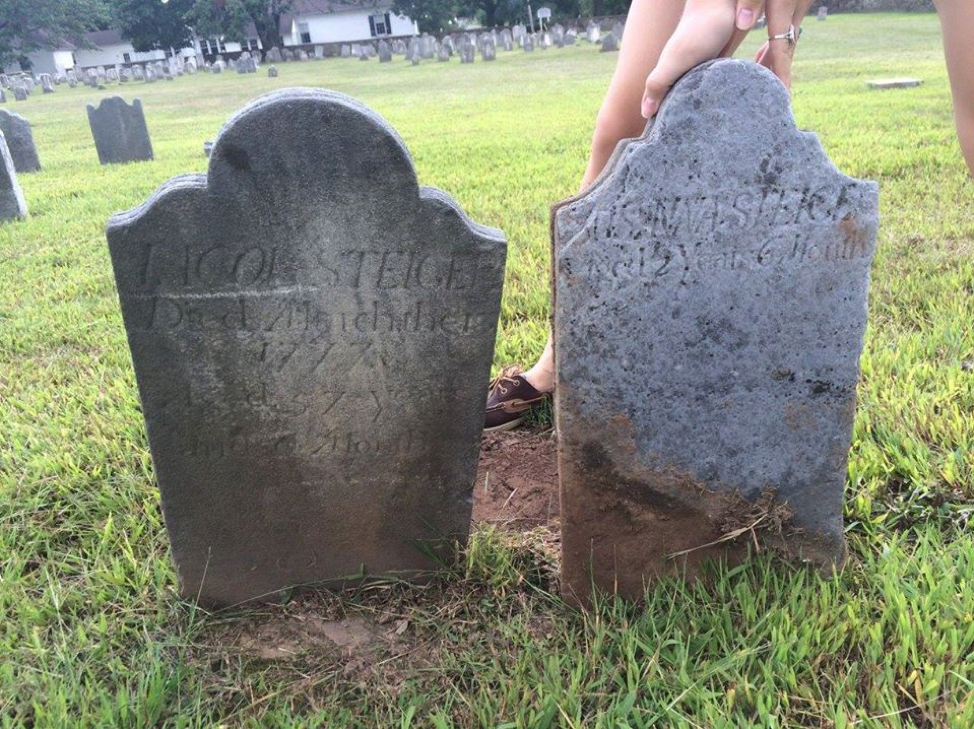
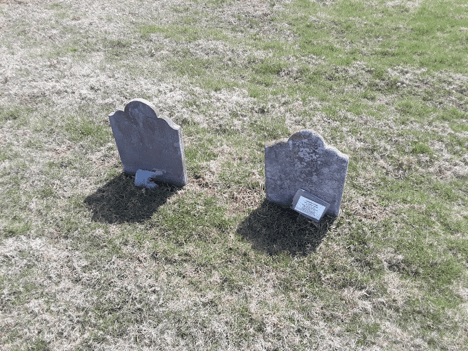
The final resting place of Jacob Steiger and his young daughter Susanna. Neither stone is in great shape and have fallen over in the past. You can see my wife had to hold up poor Susanna’s stone.

Jacob Steiger only lived nine years after the move to Whitpain. He passed away in 1777 and is buried in the Methacton Cemetery. He is buried close to the great Pennsylvania German pietist printer, Christopher Sower (Sauer) Jr. who was a business rival of Benjamin Franklin and whose estate was confiscated by the state during the Revolution when he refused to take a loyalty oath on religious grounds. Sower is best known for helping his father, Christopher Sr., to print the first European language Bible in the Western Hemisphere at the family print shop in Germantown. His grave also lies near a modern grave marker for his brother-in-law, Melchior Wagener, who married his sister Gertrude.

No photo description available.
Modern gravestone to Christopher Sower Jr., the great German Printer of colonial Pennsylvania, just yards from the grave of Jacob Steiger.
No photo description available.
A modern memorial to the Schwenkfelder pioneers buried at Methacton, including our uncle by marriage, Melchior Wagner.

Faith Friction

The records are at odds regarding the faith situation of this Steiger generation. Christiana was from a solidly German Reformed background and was probably taught the Heidelberg Catechism by her parents from young womanhood. It is recorded that Jacob’s family was probably Mennonite, further supported by the fact that he and his mother donated land for the local Mennonite congregation. Jacob is buried in that cemetery. Both the Pink Book (information taken from the Biographical Annals of Montour and Columbia Counties) and the Spare Book agree that Jacob was a minister, but the Pink Book says he was Lutheran or Reformed and the Spare book claims he was a Mennonite.  If he really was a minister, my assumption was that it was Mennonite, because in order to be a Reformed or Lutheran Pastor at that time, one would have to attend seminary training in Europe. He could have been an elder or deacon in one of the other denominations, but not a minister. However, the Mennonites frequently chose their ministers by drawing lots and required no seminary training. Therefore, if he was a minister, it is likely that he was a Mennonite.

Another view of the Methacton Meetinghouse. “A History of Worcester Township, PA” from 1976 says that during the American Revolution, Continental soldiers camped beneath the Methacton Oak mentioned above.

Another piece of evidence for the Mennonite side is the fact that their sons, Henry, Stephen, and John are all recorded as paying fines rather than show up for the government-required militia drills during the Revolution, a common practice among the pacifist Mennonites.[4] Stephen, like other prominent pacifists, was even hauled in front of the Pennsylvania Committee of Safety to determine his loyalty to the Revolutionary Cause. He was exonerated of treason and escaped the penalty of having all his property confiscated, which was the usual punishment as in the case of Christopher Sauer/Sower Jr. mentioned above.

It appears that the frenetic religious landscape of early Pennsylvania expressed itself within Jacob and Christiana’s marriage. “Christiana Steier” was a baptism and conformation sponsor for a girl in the Boehm’s Reformed[5] (Now UCC) church in Blue Bell.[6] After Jacob’s death at age 58, the records concerning Christiana have been scanty. We know by Jacob’s will that she was entitled use two rooms in the Whitpain home with a payment of 18 pounds sterling, a cow, and ten bushels of wheat per year. I have not been able to find her final resting place. Was she buried with her husband in the Methacton Cemetery? Or was she buried in Boehm’s Reformed Cemetery (Which is very close to the Whitpain Styer farm)? Or did she get remarried and end up buried somewhere else? Did she go to live with one of her children and end up buried wherever they were? Her final resting place, like much more about her life, is a mystery.

Descendants

Jacob and Christiana had the following children:

Susanna (1747-1750)- Jacob is buried next to her in the Methacton Cemetery.

Stephen (b. 1750-1811)- married Dorothy Ellis; lived across the road from Boehm’s Reformed Church. They later moved to Delaware.

Mary (1753-1812)- never married.

Henry (1755-1811)- inherited the Whitpain farm and became the wealthiest man in Whitpain Township; never married. [7]

John (1758-1816)- married Tacy Conrad (the first of several “Tacys” in our family!). She was a descendent of the original Germantown settlers and was a Quaker. There are still many Quaker Styers in Montgomery and Bucks county today.[8] John Styer built the stone barn mentioned earlier in the blog. Their daughter, Tacy, married Daniel Pastorius, a descendent of the original Francis Daniel Pastorius who led the very first Germans to Pennsylvania in 1683.

Jacob (1762-1791)- married a woman named Elizabeth; was a tanner by trade, buried at Methacton. [9]

David (1765-1825)- married Elizabeth Creger (1779-1873), buried at Methacton. David purchased the farm of his cousin David Wagener (son of Schwenkfelder pioneer, Melchior and Gertrude (nee Steiger) Wagener) after Wagener became embroiled in the religious fervor created by prophetess Jemima Wilkinson’s religious activities in the region in the late 1700’s.[10] The Pink Book says David had a twin, who was named Spare. He died in 1791. I will dedicate a later blog to the Wilkinson phenomenon after I have done some more reading on the topic.

Leonard (1768-1843)- born in the Whitpain home, married Mary Tyson; our direct ancestor and the subject of a later blog.


[1] Pink Book, p. 16.

[2] Spare Book, p. 150.

[3] Spare Book, p. 144.

[4] Spare Book, p. 146.

[5] Reverend John Philip Boehm, who we discussed in the Leonard and Elizabeth Spare episode is buried in the floor of this church.

[6] Spare Book, p. 144.

[7] Spare Book, p. 147.

[8] Spare Book, p. 147.

[9] Spare Book, p. 164.

[10] Spare Book, p. 165. Several Wageners and an Anne Styer were converted by the “Public Universal Friend” Wilkinson and moved with her to a community in Upstate New York. Subject of a later blog edition

The next blog will concern Mary Tyson Styer’s ancestry which connects our family to some of the original PA Dutch families who settled in Germantown in the seventeenth century. See you next time!

Sign on the way out of the Meetinghouse parking lot.

Meet the Family: Episode 2- Leonard and Elizabeth Spare

In the year 1746, John Stephan and Gertrude Steiger’s son Jacob married Christiana Spare, daughter of Leonard (1692-1770) and Elizabeth Spare (1690-1776), Germans who came to America in approximately 1722.[1] Like the Steigers, they settled in Worcester Township, Philadelphia (now Montgomery) County. The Spares were of the German Reformed[2] faith and took part in the establishment of that denomination on American soil.

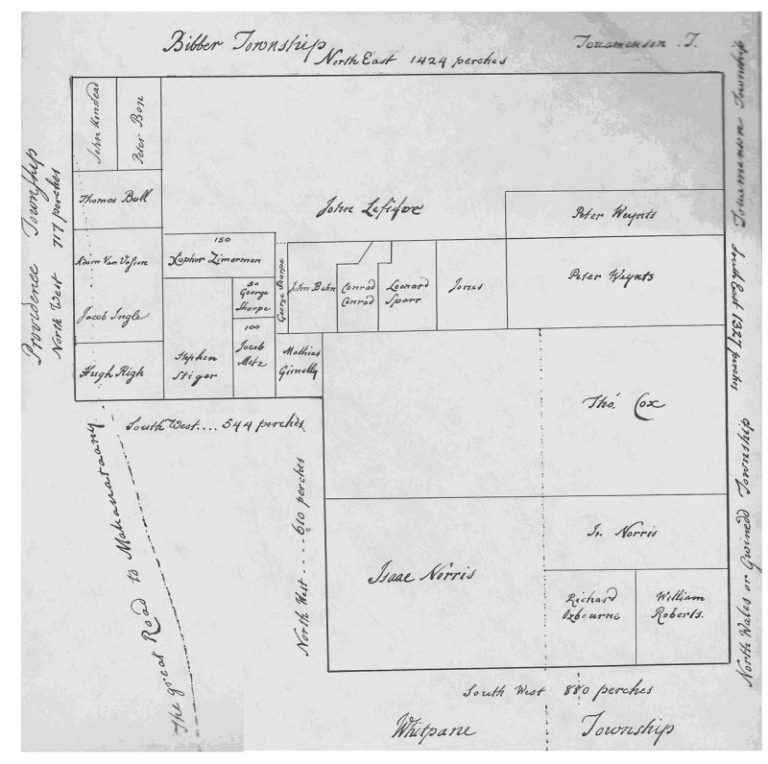
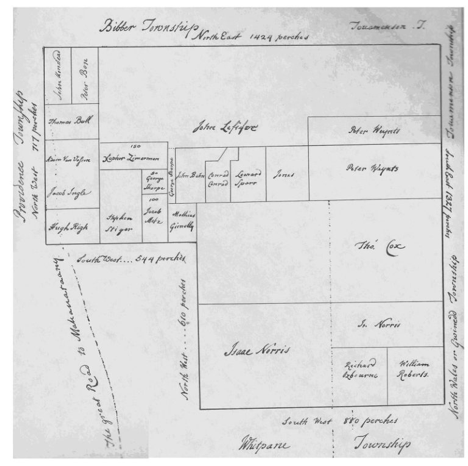
Property Map of Worcester Township, Montgomery County. Courtesy of Worcester Township Historical Society website.Leonard Spare’s property is in the middle bounded on either side by Conrad and Jones properties.

Leonard Spare served as an elder the Reformed congregation on the Skippack, which along with the Falkner Swamp[3] and Whitemarsh congregations, formed the foundation of the German Reformed denomination in America. Leonard Spare figured as a lesser player in a dramatic controversy that plagued the early history of that Church.

The signature of Leonard Spare taken from the Spare Family Genealogy book.

The Boehm Controversy

There were many issues facing European religious leaders in colonial Pennsylvania. There was no government-established church, so individuals were free to pick and choose from the marketplace of religious ideas flourishing at the time, and the Lutheran and Reformed churches in Germany drug their feet in sending ordained pastors to serve the spiritual needs of their colonial flocks. Due to the total lack of organization and absence of ministers, religious groups like the Moravians actively and successfully recruited members of the German Lutheran and Reformed congregations.  It was into this context that a young schoolmaster named John Phillip Boehm entered the scene.[4]

Due to Beohm’s educated background and Reformed faith, it was not long before the pastor-less Reformed elders (including our ancestor, Leonard Spare) listed above asked him to read sermons during worship services. As time went on, he was prevailed upon to preach his own sermons and perform baptisms, communion, weddings, and funerals, all activities ordinarily relegated to ordained ministers. This arrangement proved fruitful, until 1727, when George Michael Weiss, the first ordained German Reformed minister sent by the denomination to the New World, arrived.

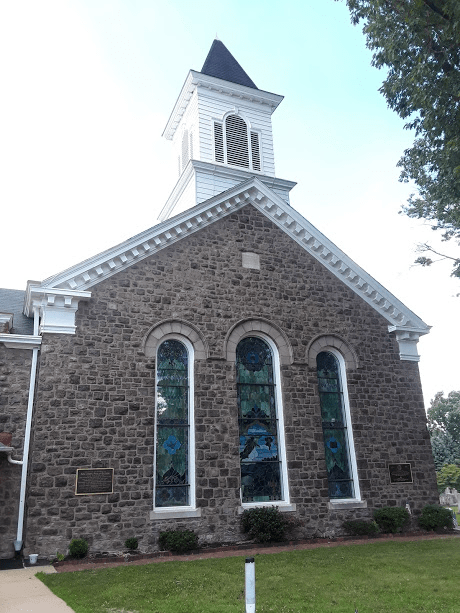
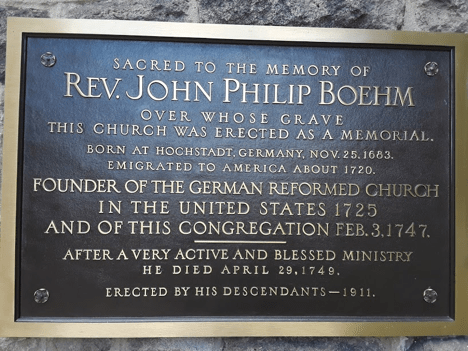
Boehm’s Reformed Church (UCC) near Blue Bell, PA. One of the last of many congregations that Boehm organized- and his final resting place. Photo taken by the author.

Weiss was a young man, full of the sense of power and authority which had been granted to him by the Reformed fathers in Germany to organize and establish the denomination in the New World, and to make sure congregations were not being led by heretics and charlatans. There was a real problem in colonial Pennsylvania with congregations being led by ministers who either did not have educational credentials or who had been censured by the religious authorities in Europe for theological or moral crimes. Weiss had been sent to restore order to the struggling denomination. Boehm was his first target.

Although Boehm did not share the bad qualities of the various spiritual hucksters and schlockmeisters who haunted the pulpits of early colonial PA (he actually seems to have done his best to remain faithful to the tenets of the Reformed faith), he did not have any credentials and a controversy ensued between he and Weiss and their supporters. This issue was only resolved when in 1729 Boehm traveled to New York to receive ordination from the Dutch Reformed authorities there. He brought with him a petition signed by all the elders who still supported his work, including Leonard Spare. In the petition, they apologized for their rash but understandable decision to call him to ministry without credentials; they vouched for his good character and theological soundness and asked for him to be ordained as a minister. Boehm received his ordination from the Dutch Reformed Classis (regional denominational authority like a synod, conference, or presbytery) of New York, and the controversy between he and Weiss came to a happy end.

A monument to Boehm on the side of Boehm’s Reformed Church (UCC)

Leonard Spare, along with his son Philip, helped organize the German Reformed Church in Worcester Township, now known as Wentz’ UCC, in 1734.[5] He, his wife, Elizabeth, and many decedents are buried in the cemetery there. If you visit, it is still fairly easy to find Leonard and Elizabeth’s gravesites if you know what the stones look like. The writing is fairly worn. Better photos of the stones are available on their Find a Grave pages. And of course, it should be mentioned that Leonard Spare is the original “Leonard” namesake in our family- the name appears several times throughout our genealogy. He and Elizabeth had the following children:

  1. Philip (~1720-1799); married Anna Dorothea Gerber; served in the Revolution; bought the Spare family farm after the death of his father.
  2. Christiana (married Jacob Steiger); subject of the next blog.
  3. Margaret (married Martin Neubecker); many of their descendants moved to upper Dauphin County.
  4. Elizabeth (1734-1811, married Daniel Yost); the Yost’s were an important family in Montgomery county, and one of Daniel Yost’s sisters, Anna Maria, married Rev. Boehm’s son, John Phillip Boehm Jr.
  5. There may have been other children.[6]
The graves of Elizabeth and Leonard Spare at Wentz’ UCC in Worcester Township, PA. Photo taken by the author.
Image result for wentz reformed church
Wentz’ Reformed Church (UCC) where many Spare and Tyson relatives are buried. Courtesy of http://www.shambaugh.org

Probate Records

Leonard Spare’s last will and testament was drawn up by the prominent colonial lawyer, Benjamin Chew.[7] When Leonard died, his co-executors were his son Philip Spare, and his son-in-law, Jacob Steiger (Styer).[8] Some household items appraised by A. Zimmerman and our uncle Melchior Wagner (Schwenkfelder pioneer from the first blog, married our aunt Gertrude Styer) included a Tall-case clock, looking-glass, tea table, a table and chairs, pewter and tin tableware, iron, brass, and earthen cookware and an iron stove. Sadly, unlike John Stephan Styer’s estate, Leonard Spare’s books are not listed by title.  His farm equipment included a plough, a harrow, a wagon, and wool processing equipment.

Image result for benjamin chew
Benjamin Chew, Leonard Spare’s lawyer. Picture courtesy of Wikipedia

The inventory listed the Spares as having barrels of wheat and flaxseed, 6 ½ bushels of rye, 4 bushels of oats, 10 acres of corn in the ground, partially processed flax, 5 yards of finished linen cloth, and 9 yards of finished wool cloth. The Spare livestock included 4 cows, one calf, an old black mare, a colt, 5 sheep, and 1 lamb. Other items included a keg of vinegar, a painted box, a set of bellows and two pounds and 12 shillings worth of bacon and gammon (cured pork). Leonard Spare also owned beehives, making him the father of Styer beekeeping tradition which reached its zenith during the life of Charles C. Styer (1888-1964) who is remembered as a most interested and successful apiarist.

The next blog will focus on the daughter of Leonard and Elizabeth (Christiana) and the son of John Stephan and Gertrude Styer (Jacob).


Endnotes:

[1] Styer Pink Book, 16; Spare Family Book, 1.

[2] The German Reformed Church is a Calvinistic denomination founded by Ulrich Zwingli and others in the decades following Martin Luther’s break with the Roman Catholic Church. Most German Reformed Churches joined with Congregational Churches in a union that created the United Church of Christ, with a small conservative remnant remaining under the name Reformed Church in the United States.

[3] Falkner Swamp Reformed Church (UCC) is considered to be the oldest German Reformed congregation in America.

[4] The following controversy is explained in detail in the Spare Book, pages 5-15 as well as in Volume 1 of Henry Harbaugh’s Fathers of the German Reformed Church in Europe and America (1857).

[5] Spare Book, 16.

[6] Spare Book, 18.

[7] Chew’s stately Georgian-style house, Cliveden, in the Germantown neighborhood of Northwest Philadelphia is a historic house museum which was preserved in part due to its use as a refuge for British soldiers in the Battle of Germantown during the Revolutionary War. If you are ever in the area, it is worth a visit.

[8] This and the following are drawn from the actual Leonard Styer probate documents that I accessed on Ancestry.

Works Cited

Pennsylvania, Wills and Probate Records, 1683-1993 for Leonard Spare. 1736. Retrieved from Ancestry.com.

The Spare Family Association. The Spare Family- Leonard Spare and his Descendants. (Norristown Press: Norristown, 1931).

Styer, Peter C. The Styer Family. (Edinboro, 1989). i.e. “The Pink Book”

Meet the Family: Episode 1- Johan Stephan and Gertrude Steiger

Origins

For the first blog, I will touch on our immigrant Styer ancestors, John Stephan (or Johann Stephanus) and Gertrude Steiger (Or Styger). John Stephen is thought to have been born in the year 1688, probably in Bohemia, in Central Europe. His birth certificate was preserved by a cousin of ours, Freas Styer, who lived in Norristown, PA about a century ago.[1] A transcription of the certificate is provided in your Styer Pink Book.[2]  His parents, John Nicholas and Catherine Steiger, remained in Europe when John Stephan and his wife Gertrude[3] left for America, where they arrived between the years 1712 and 1714. They probably landed in the Port of Philadelphia and settled in Germantown until the year 1724, when they purchased 200 acres to farm in Worcester (Pronounced Wor-sester by locals) Township in Philadelphia (now Montgomery) County.

A Map of the original property holders of Worcester Township, Montgomery County, PA. You can pick out the properties of our immigrant ancestors Stephan Steiger and Leonard Spare, as well as step-ancestor, Peter Wentz.
Retrieved from Worcester Historical Society website.

The Pink Book lists some interesting antiques that were still held by the Montgomery County Styer’s at the time of the writing of the Biographical Annals of Montour and Columbia Counties (written around the turn of the 20th century). These articles included a leather booklet that contained family records and a Dutch cupboard decorated with portraits of George, Elector of Hanover/King of England. One wonders if either relic still exists.

Religion

It is thought that John Stephan and Gertrude Steiger were Mennonites, but their decedents quickly converted to other denominations. Our branch eventually moved toward Presbyterian piety, while some branches that remained in Montgomery County shifted toward Quakerism or other faith traditions. I will touch more on Styer/Steiger piety in the blog concerning their son Jacob and his wife Christiana (nee Spare). 

Descendants

The Biographical Annals of Montour and Columbia Counties, cited in the Pink Book, list the following children of John Stephan and Gertrude Steiger:

Catherina (or Edwina), b. 1712,

Anna, b. 1715,

Nicholas, 1717-1736,

Jacob, 1719-1777- (our ancestor),

Stephen, 1720-1753,

Daniel b. 1723,

Susannah b. 1725,

Gertrude b. 1729—1798 (she married Melchior Wagner, a Schwenkfelder[4] pioneer).


Burial

John Stephan died in 1736 and was survived by Gertrude until 1755. Although neither has an existing gravestone, there is still a way to visit the location of their remains.  According to a tradition cited in the Spare Family book, after John Stephan was buried in the family cemetery, Gertrude and her son Jacob donated land including this cemetery to build Methacton Mennonite Meetinghouse and burial ground.[5] Thus the family graveyard, became the basis for the current Methacton Mennonite cemetery. Their son (and our ancestor) Jacob Steiger’s grave still stands there, so when you visit his grave, one can be reasonably certain that his parents are buried somewhere nearby.

Probate Records

We are fortunate to have access to John Stephan’s probate records as well as the itemized list of his possessions as they were sold at auction in 20 May 1736.[6] The list included household supplies such as 16 earthenware pots, numerous sheets, a table, three chairs, several benches, pewter dishware and cast iron cookware. Some of the farm equipment listed included two ploughs, a wagon, and a harrow, sickles, dung forks, and grain cradles. Their livestock included eighteen sheep and seven lambs for wool production, an eleven-year-old roan mare, a two-year-old iron gray colt, a four-year old proven young horse, an old twenty-year-old roan horse, a thirteen-year-old proven horse, and a six-year-old black horse. They also owned a side-saddle, a “man saddle” and several bells, probably for livestock.

Image result for flax heckle
An example of a heckle, used to comb out the unwanted chaff-like parts out of flax when processing it into pure linen fibers.

The Steigers owned a flax heckle, so it is safe to assume that they grew and processed flax into linen. The founders of Germantown were mostly weavers, so they may have sold the thread that they produced to folks in Germantown or exchanged services to have them make cloth for family use.  His probate shows that he owed 1 pound 18 shillings to Conrad Stam for weaving. At the time of his death, John Stephan not only had an acre of flax in the ground, but also had fields planted with wheat, corn, barley, and rye.  Like the vast majority of colonial Americans, the Steigers were not opposed to the use of alcohol. They sold two barrels of hard cider at the auction and were listed as being indebted to Jacob Engle for an order of rum that cost 14 shillings.  

The sale inventory also gives us a glimpse into the spiritual lives of John Stephan and Gertrude. The three books sold at auction included a copy of the New Testament, Johan Arndt’s True Christianity (an early Pietist treatise on the Christian life, that you can actually look up and read online) and Johan Arndt’s Postill, or German-language Bible commentary. This selection of religious literature demonstrates that our Steiger Ancestors were typical of early Pennsylvania Dutch settlers in that they brought Pietistic theology with them from Europe as they came to America. [7]

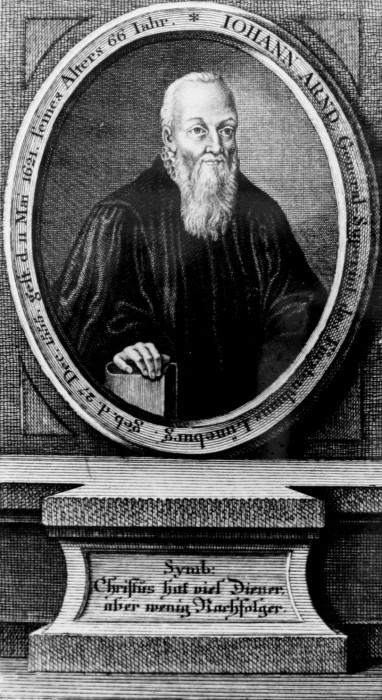
Johann Arndt (1555-1621), German Pietistic theologian whose “True Christianity” and “Postil” (or Bible Commentary) John Stephan and Gertrude Steiger owned at the time of John Stephan’s death in 1736.

Next time on the Styer Stories Blog, we will take a look at another set of immigrant ancestors from Germany, Leonard and Elizabeth Spare, whose daughter Christiana, married John Stephan and Gertrude’s son, Jacob.


Endnotes:

[1] Spare Family Association, The Spare Family-Leonard Spare and his Decedents, (Norristown: Norristown Press, 1931), 142.

[2] If your family desires a Styer Pink Book, feel free to message me on Facebook.

[3] The Styer Pink Book, Biographical Annals of Montour and Columnbia Counties, and John Stephan’s probate records all record her name as Gertrude. The Spare Family book records it as Catherine but appears to be incorrect.

[4] The Schwenkfelders are a small anabaptist Christian denomination from Silesia which followed the teachings of Caspar Schwenkfeld. They still have some churches in Montgomery County, PA.

[5] Spare Family, 143.

[6] The following was discovered using Ancestry.

[7] For an excellent overview of Pietism and its influence among the PA Dutch, see Stephen L. Longenecker, Piety and Tolerance: Pennsylvania German Religion 1700-1850, ( Metuchen: Scarecrow, 1994).

Welcome to Styer Stories!

Welcome to the Styer Stories blog! Researching family history is exciting and is intensely gratifying. The aim of this blog is to be a place where Styer historians and genealogy enthusiasts can share their stories and research with the rest of the clan (Broadly, the descendants of John Stephan and Gertrude Steiger/Styer, but more particularly the descendants of Cyrus Fairchild and Harriet (Brugler) Styer) . I plan to begin by doing a series of posts called “Meet the Family,” which will focus on each of our direct Styer ancestors (and the matriarchal lines like the Spares, Tysons, Fairchilds, Bruglers, Crossley’s, as well). The information in these posts will be drawn not only from the great Styer “Pink Book,” but other sources I have discovered during my research, like the 1931 Spare Family genealogy book. At some point when this task is completed, I plan to do a transcription and commentary on the 1913 diary of our Grandmother Emily Crossley Styer. Hopefully this blog can become a place where Styer cousins can share old stories, memories, recipes, pictures, and traditions among the Styer Freindschaft (PA Dutch for extended family)

I am always looking for ways to grow, so feel free to comment with any suggestions and questions. My goal is to gain a better understanding of our ancestors. What were they like? How did they live? What did they value? And how did their lives impact ours? Join me on this journey into our heritage.

Design a site like this with WordPress.com
Get started