Origins
For the first blog, I will touch on our immigrant Styer ancestors, John Stephan (or Johann Stephanus) and Gertrude Steiger (Or Styger). John Stephen is thought to have been born in the year 1688, probably in Bohemia, in Central Europe. His birth certificate was preserved by a cousin of ours, Freas Styer, who lived in Norristown, PA about a century ago.[1] A transcription of the certificate is provided in your Styer Pink Book.[2] His parents, John Nicholas and Catherine Steiger, remained in Europe when John Stephan and his wife Gertrude[3] left for America, where they arrived between the years 1712 and 1714. They probably landed in the Port of Philadelphia and settled in Germantown until the year 1724, when they purchased 200 acres to farm in Worcester (Pronounced Wor-sester by locals) Township in Philadelphia (now Montgomery) County.
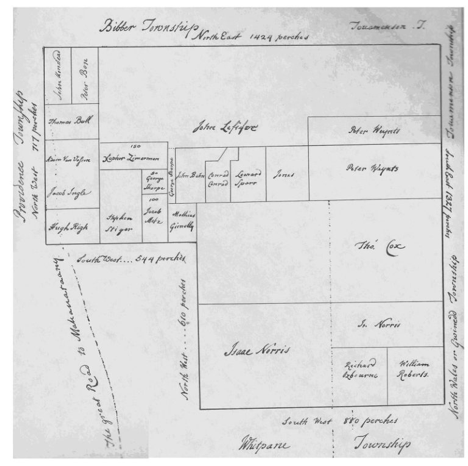
Retrieved from Worcester Historical Society website.
The Pink Book lists some interesting antiques that were still held by the Montgomery County Styer’s at the time of the writing of the Biographical Annals of Montour and Columbia Counties (written around the turn of the 20th century). These articles included a leather booklet that contained family records and a Dutch cupboard decorated with portraits of George, Elector of Hanover/King of England. One wonders if either relic still exists.
Religion
It is thought that John Stephan and Gertrude Steiger were Mennonites, but their decedents quickly converted to other denominations. Our branch eventually moved toward Presbyterian piety, while some branches that remained in Montgomery County shifted toward Quakerism or other faith traditions. I will touch more on Styer/Steiger piety in the blog concerning their son Jacob and his wife Christiana (nee Spare).
Descendants
The Biographical Annals of Montour and Columbia Counties, cited in the Pink Book, list the following children of John Stephan and Gertrude Steiger:
Catherina (or Edwina), b. 1712,
Anna, b. 1715,
Nicholas, 1717-1736,
Jacob, 1719-1777- (our ancestor),
Stephen, 1720-1753,
Daniel b. 1723,
Susannah b. 1725,
Gertrude b. 1729—1798 (she married Melchior Wagner, a Schwenkfelder[4] pioneer).
Burial
John Stephan died in 1736 and was survived by Gertrude until 1755. Although neither has an existing gravestone, there is still a way to visit the location of their remains. According to a tradition cited in the Spare Family book, after John Stephan was buried in the family cemetery, Gertrude and her son Jacob donated land including this cemetery to build Methacton Mennonite Meetinghouse and burial ground.[5] Thus the family graveyard, became the basis for the current Methacton Mennonite cemetery. Their son (and our ancestor) Jacob Steiger’s grave still stands there, so when you visit his grave, one can be reasonably certain that his parents are buried somewhere nearby.
Probate Records
We are fortunate to have access to John Stephan’s probate records as well as the itemized list of his possessions as they were sold at auction in 20 May 1736.[6] The list included household supplies such as 16 earthenware pots, numerous sheets, a table, three chairs, several benches, pewter dishware and cast iron cookware. Some of the farm equipment listed included two ploughs, a wagon, and a harrow, sickles, dung forks, and grain cradles. Their livestock included eighteen sheep and seven lambs for wool production, an eleven-year-old roan mare, a two-year-old iron gray colt, a four-year old proven young horse, an old twenty-year-old roan horse, a thirteen-year-old proven horse, and a six-year-old black horse. They also owned a side-saddle, a “man saddle” and several bells, probably for livestock.

The Steigers owned a flax heckle, so it is safe to assume that they grew and processed flax into linen. The founders of Germantown were mostly weavers, so they may have sold the thread that they produced to folks in Germantown or exchanged services to have them make cloth for family use. His probate shows that he owed 1 pound 18 shillings to Conrad Stam for weaving. At the time of his death, John Stephan not only had an acre of flax in the ground, but also had fields planted with wheat, corn, barley, and rye. Like the vast majority of colonial Americans, the Steigers were not opposed to the use of alcohol. They sold two barrels of hard cider at the auction and were listed as being indebted to Jacob Engle for an order of rum that cost 14 shillings.
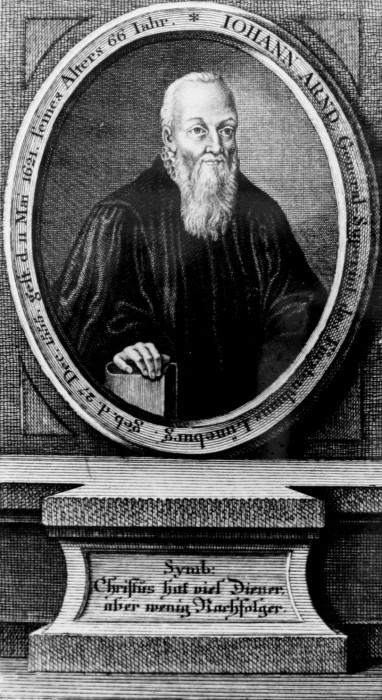
The sale inventory also gives us a glimpse into the spiritual lives of John Stephan and Gertrude. The three books sold at auction included a copy of the New Testament, Johan Arndt’s True Christianity (an early Pietist treatise on the Christian life, that you can actually look up and read online) and Johan Arndt’s Postill, or German-language Bible commentary. This selection of religious literature demonstrates that our Steiger Ancestors were typical of early Pennsylvania Dutch settlers in that they brought Pietistic theology with them from Europe as they came to America. [7]
Next time on the Styer Stories Blog, we will take a look at another set of immigrant ancestors from Germany, Leonard and Elizabeth Spare, whose daughter Christiana, married John Stephan and Gertrude’s son, Jacob.
Endnotes:
[1] Spare Family Association, The Spare Family-Leonard Spare and his Decedents, (Norristown: Norristown Press, 1931), 142.
[2] If your family desires a Styer Pink Book, feel free to message me on Facebook.
[3] The Styer Pink Book, Biographical Annals of Montour and Columnbia Counties, and John Stephan’s probate records all record her name as Gertrude. The Spare Family book records it as Catherine but appears to be incorrect.
[4] The Schwenkfelders are a small anabaptist Christian denomination from Silesia which followed the teachings of Caspar Schwenkfeld. They still have some churches in Montgomery County, PA.
[5] Spare Family, 143.
[6] The following was discovered using Ancestry.
[7] For an excellent overview of Pietism and its influence among the PA Dutch, see Stephen L. Longenecker, Piety and Tolerance: Pennsylvania German Religion 1700-1850, ( Metuchen: Scarecrow, 1994).
 Styer Stories